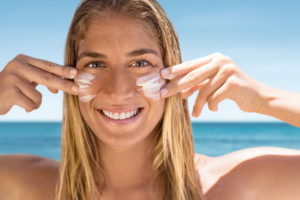
Choosing a Sunscreen
 Share
Share 
A healthy and beautiful tan is impossible without using high-quality sunscreens. They allow you to benefit from sun exposure without negative consequences. However, not all sunscreens are equally effective. Some are completely useless. That is why it is very important to choose products for safe tanning correctly. So how do you choose a sunscreen, and what should you focus on when making your choice?

Why Sunscreens Are Needed and How They Work
Sunbathing can have a beneficial effect on the body, but excessive sun exposure may lead to burns, negatively affect the skin, and accelerate its ageing. UVA and UVB rays activate the synthesis of melanin and vitamin D, but their effects also have a negative side. That is why the skin needs to be protected with sunscreens that reduce this harmful impact.
Sunscreens can be blocking or screening.
Blocking products help reflect rays, while screening products form a film that absorbs them. Sunscreens were originally developed to protect against UVB rays, which cause sunburn and can provoke the development of malignant skin tumours. Modern cosmetic developers state that UVA rays accelerate skin ageing, so protection against their effects is equally important. Not all products provide simultaneous protection against a broad spectrum of ultraviolet radiation, so this should be taken into account when choosing a sunscreen.
Sunscreens contain chemical compounds that absorb ultraviolet rays and convert their energy. These compounds include octocrylene, oxybenzone, Parsol filters, and others. They may also contain antioxidants, which help reduce the effects of oxidative stress caused by ultraviolet exposure. In addition, manufacturers may add vitamin complexes to cosmetic products, such as vitamin E.
How to Choose a Sunscreen
Sunscreens differ primarily in their level of SPF protection. SPF (Sun Protection Factor) indicates the level of protection against ultraviolet rays. It may be low – SPF 6 to 15, medium – 15 to 30, high – 30 to 40, or very high – 50+. This value indicates what proportion of UVB radiation will be blocked or absorbed by the filters.
When choosing a sunscreen, you should first of all consider your skin type.
Type I: very fair skin, light hair, and light eyes. These are people with very low natural skin protection against ultraviolet radiation. This skin type tolerates sunlight poorly and, instead of tanning, quickly turns red and burns. People with this skin type should avoid direct sunlight and stay under an awning or in the shade. They need to use products with a protection factor of at least SPF 30. However, during the first days of a holiday, products with a higher SPF are more appropriate.

Type II: fair skin, Nordic appearance type. This skin type is more tolerant of sunlight than Type I, but it still requires particular caution. During the first days of a holiday, time spent in direct sun should be minimal, and sunscreens should be used throughout the entire holiday period. Sun exposure should not exceed 15 minutes. During the first days, sunscreens with SPF 30 should be used, and later the protection factor can be reduced to SPF 15.
Type III: fair skin, but people with this type usually have dark hair. This skin type is common among many residents of Central and Eastern Europe. The skin tans well, but the risk of sunburn still remains. At the beach, it is better to use products with SPF 15, and later the protection can be reduced to SPF 10.
Type IV: dark or olive-toned skin that tans very easily and rarely burns. This skin type is common among people from the Mediterranean region and the East. Darker skin is more resistant to sunlight, but it should not be exposed to the sun without protection for more than 40 minutes. Products with SPF 10 should be used, and later the protection can be reduced to SPF 6.
Type V: people with this skin type mainly live in South America and North Africa. They tan very easily and rarely burn. During the first days at the beach, products with SPF 6 should be used; later, with moderate sun exposure, minimal protection may be sufficient, but it is important not to forget to moisturise the skin.
Type VI: people with this skin type have dark skin. Historically, this skin type is characteristic of people from Africa and Indigenous peoples of Australia. Their skin is best adapted to sun exposure and is much less likely to develop sunburn. Products with minimal UVB protection may be sufficient for them, but UVA protection is still important because it helps reduce the risk of skin photoageing. In addition, the skin should be actively moisturised after sun exposure.

Types of Sunscreens
There are several types of sunscreens, which differ in form and method of application. When choosing a specific product, it is important to take skin type into account, as this affects its effectiveness. For example, creams are suitable for normal and dry skin, while liquid products are better for oily and combination skin.
Forms of Sunscreens:
- cream;
- oil;
- milk;
- lotion;
- gel.
The most common form is cream. It is a universal option available with all SPF levels. Like lotion, it does not require frequent reapplication and performs its functions quite well.
Tanning milk is easy to apply, but it needs to be reapplied often. A gel-based product is more long-lasting and is therefore recommended for oily skin. In addition, gel does not add an oily shine to this skin type.
Tanning oil is usually available with a low SPF level. It is designed to help achieve a more intense tan. It is better not to use it during the first days of active sun exposure.
Rules for Using Sunscreens
Before buying a product, it is important to read the instructions carefully. Make sure it is intended specifically for tanning in the sun, not for use in a tanning bed. The composition of each product is listed on its packaging, but if you have very sensitive skin or are prone to allergic reactions, a patch test should be performed before use. Apply the product to the inner bend of the elbow, and if no redness, itching, or irritation appears within half an hour, the product can be used.
For children, it is better to use products with a special “for children” label. These products should be applied to a child’s skin as often as they are applied to adults’ skin. In general, the rules for using sunscreens are similar for children and adults.
The product should be applied to the skin in an even layer 15–20 minutes before going out into the sun. As mentioned earlier in the article “Rules for Healthy Tanning”, sunscreen should not be used sparingly: it should be applied generously and reapplied regularly.
You should not rely only on the SPF level or calculate protection time using the SPF × 10 formula. This value does not mean that, after applying the product, you can safely stay in the sun for several hours without reapplying it. The product gradually rubs off on towels, washes off in water, mixes with sweat, and loses the evenness of its coverage. Therefore, it should be reapplied every 2 hours, as well as after swimming, heavy sweating, or drying the skin with a towel. The fairer the skin, the more carefully you should approach regular reapplication.
There are water-resistant sunscreens, but they lose their properties after several swims, prolonged time in the water, heavy sweating, and vigorous rubbing with a towel. Therefore, they should be reapplied almost as often as regular sunscreens. After sun exposure, be sure to wash off all products applied during the day and moisturise the skin.
Do not neglect sunscreens – this will help ensure that your holiday is not spoiled by the consequences of sunburn or so-called sun allergy, while your skin will be protected from hyperpigmentation and premature ageing. As a bonus, you will get a beautiful, even tan that lasts much longer than a tan developed without sun protection. Take care of yourself and love yourself!
Author: Anna BUNYAK
Editor: Nataliya CHAYKA – Editor-in-Chief of ESTportal
Translation: Nataliya CHAYKA
First published: 2017
Updated in line with current guidelines and relevant research: 2026